Showing posts with label Economic conditions. Show all posts

Thursday, March 11, 2010

Z1

Today the quarterly Flow of Funds (aka Z1) report was released by the Federal Reserve. What is the Flow of Funds report? Imagine the USA was a company: it's income statement would be called GDP report, and it's balance sheet would be the Flow of Funds. In my opinion this is the most important economic statistics release there is.

Unfortunately for this blog and its readers, I am quite busy at the moment getting ready to commence employment at Keefe, Bruyette and Woods research department in London, and I'm likely to become more and more busy as days go by. I will thus ask my dear readers to confer to the fantastic blogs linked below in the right column of this page for analysis of  and commentary on the all-important Z1 report.

Monday, November 23, 2009

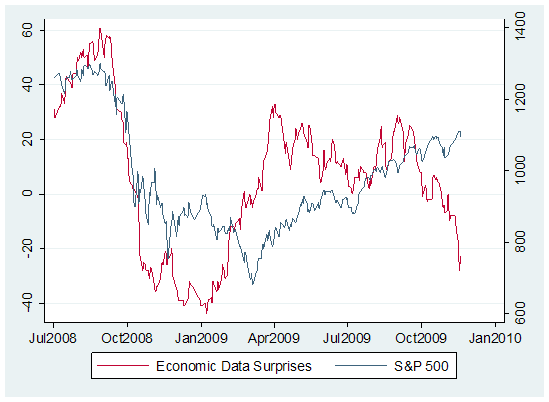
Hester: Economic Data Surprises index

I love Mondays. Why? Every Monday John Hussman, maybe the most brilliant mind in the business (let's say it's a tie with El-Erian), publishes his weekly market comment:
The cumulative tally of surprises in economic reports (a metric we credit to Bridgewater, which Bill Hester adapted here), has also turned down decidedly. Though the historical correlation is not always as strong as it has been during the recent downturn, shifts in economic surprises have tended to lead market turns in recent years.


Still, with market internals mixed but not clearly collapsing, prices strenuously overbought but still achieving marginal new highs, and valuations unfavorable but not as extreme as they were in 2000 or 2007, investors may be convinced that there is still a little bit of punch in the bowl

Saturday, November 14, 2009

Building permits and U.S. GDP growth

The highest correlation that can be found between building permits and subsequent year-over-year GDP growth is 0.64:


(Note: This is a 15-months rate of change, and Building Permits are advanced 6 months.)

This illustrates one of the missing private demand leg in this recovery.

Tuesday, November 10, 2009

October Senior Loan Officers Survey

From Asha Bangalore: Improved Picture of Lending Conditions, but Demand for Loans was Weak.

Note: this is a well-made report, however it still belongs to the "less bad news" camp. We're not yet seeing "good" news yet from either supply of or demand for loans.

Tuesday, November 3, 2009

The current state of the economy

From John Hussman:
One possibility, which is clearly the one that Wall Street has subscribed to, is that the recent downturn was a standard, if somewhat more severe than normal, post-war recession; that the market's recent strength is an indication that it is looking forward to a full “V-shaped” recovery, and that the positive print for third-quarter GDP is a signal that the recession is officially over. Applying the post-war norms for stock market performance following the end of a recession, the implications are for further market strength and the elongation of the recent advance into a multi-year bull market.
The alternate possibility, which is the one that I personally subscribe to, is that the recent downturn was the initial phase of a more prolonged deleveraging cycle; that the advance we've observed in recent months most likely represents mean-reversion – qualitatively and quantitatively similar to the large and often abruptly terminated “clearing rallies” of past post-crash markets; that major credit losses are continuing quietly but are going unreported thanks to changes in accounting rules by the FASB this past spring, which allowed for “substantial discretion” in accounting for loan losses and deterioration in the value of securitized mortgages; that a huge second-wave of mortgage losses can be expected from a reset schedule on Alt-A and Option-ARMs that has just started (following a lull in the reset schedule since March) and will continue into 2010 and 2011; that intrinsic economic activity remains abysmal; that recent GDP growth is an artifact of massive fiscal stimulus that is unlikely to have sustained follow-through; and that recent market valuations are not representative of those observed at the end of most post-war recessions, but are instead similar to those observed at major market peaks prior to the mid-1990's.

Sunday, July 26, 2009

Contradicting McCulley

It is not a great day for me as I am writing this post which is a rebutal to Paul McCulley, one of the persons from whom I have learned the most. He tends to be too keynesian sometimes, and his last month's commentary is one example:

To be sure, we are presently living in an unusual world, in that the Fed is pegging the Fed funds rate at effectively zero. But it is not stimulating robust demand for credit, or alternatively, it is not stimulating bankers to gin up demand for credit by loosening terms and conditions to prospective borrowers. Actually, reality is probably a bit of both: reluctant borrowers and reluctant lenders.

In my opinion this is completely wrong. The Fed's policies have indeed stimulated robust supply of (risk-free) credit from the bankers and robust demand for credit by the Treasury. I don't have a chart at hand showing of how much of the Treasury's recent borrowing has been financed by the U.S. financial system, but I trust that it's the bulk of it.

Thus, we can categorically say that the near-zero Fed funds rate is not, for the moment, fueling an inflationary pace of aggregate demand growth relative to the economy’s supply potential. And neither is the Fed’s Credit Easing, which is the proximate cause for the explosion of excess reserves in the system. Yes, in the fullness of time, zero Fed funds could conceptually re-ignite borrowers’ and lenders’ mojo. Indeed, that’s precisely the Fed’s objective. And if and when that objective is achieved, the Fed funds rate will need to be hiked to temper the re-ignited mojo, so as to prevent the economy from overheating.
This part is way too keynesian even for McCulley. Kasriel finds a correlation of 0.64 between M2 and inflation, and only 0.08 (!) between the output gap and inflation. Also, look at how inflation flamed up in 1934 while the unemployment rate was in the high teens.

Tuesday, February 3, 2009

January Senior Loan Officer Survey Includes Many Positive Aspects

A summary of the Survey from Asha Bangalore:

January Senior Loan Officer Survey Includes Many Positive Aspects
Asha G. Bangalore, Northern Trust Global Economic Research
February 2, 2009
The Senior Loan Officer survey of January 2009 contains many noteworthy aspects that bear good tidings. There were fewer bank officers reporting they had tightened loan underwriting standards for commercial and industrial loans for both small and large firms in January compared with December (see charts 1 and 2). The fact that some bank officers have eased mortgage underwriting standards is notable but the levels still exceed the peak reported in 2001 (see charts 1 and 2). In the case of both large and small firms, the demand for loans was weaker in January compared with December. Although the history of these data is short, in 2001, the demand for loans turned around only after the recession had reached its last leg, where as the peak for the number of banks reporting tightening standards peaked slightly ahead.

This is one of the first indicators to point towards a recovery.